
The Trigeminal Nerve: The Face's Swiss Army Knife

Updated: Jul 15

The Trigeminal nerve is quickly becoming one of our favorite cranial nerves because of its incredible "Swiss Army knife" abilities for pain and relaxation.
When we look at its three major branches, it's easy to see why.
When Cranial Nerve V (the Trigeminal nerve) becomes irritated or overly sensitive, people may experience:
Forehead headaches
Eye pain or pressure
Sinus and upper nose discomfort
TMJ pain
Cheek pain
Upper/ Lower lip discomfort
Tooth sensitivity or pain
Tongue irritation or unusual sensations
One nerve. Three major branches. A surprisingly large influence on how the face feels.
How Vibration May Help
One of my favorite ways to help calm an irritated nervous system is through gentle vibration.
I typically use SCP's Vibration Ball, but during class Dr. Perry introduced us to another fascinating tool: the Z-Vibe.
Originally designed for speech therapy, the Z-Vibe has become popular among speech-language pathologists, occupational therapists, physical therapists, and some dentists for oral sensory input and jaw relaxation.
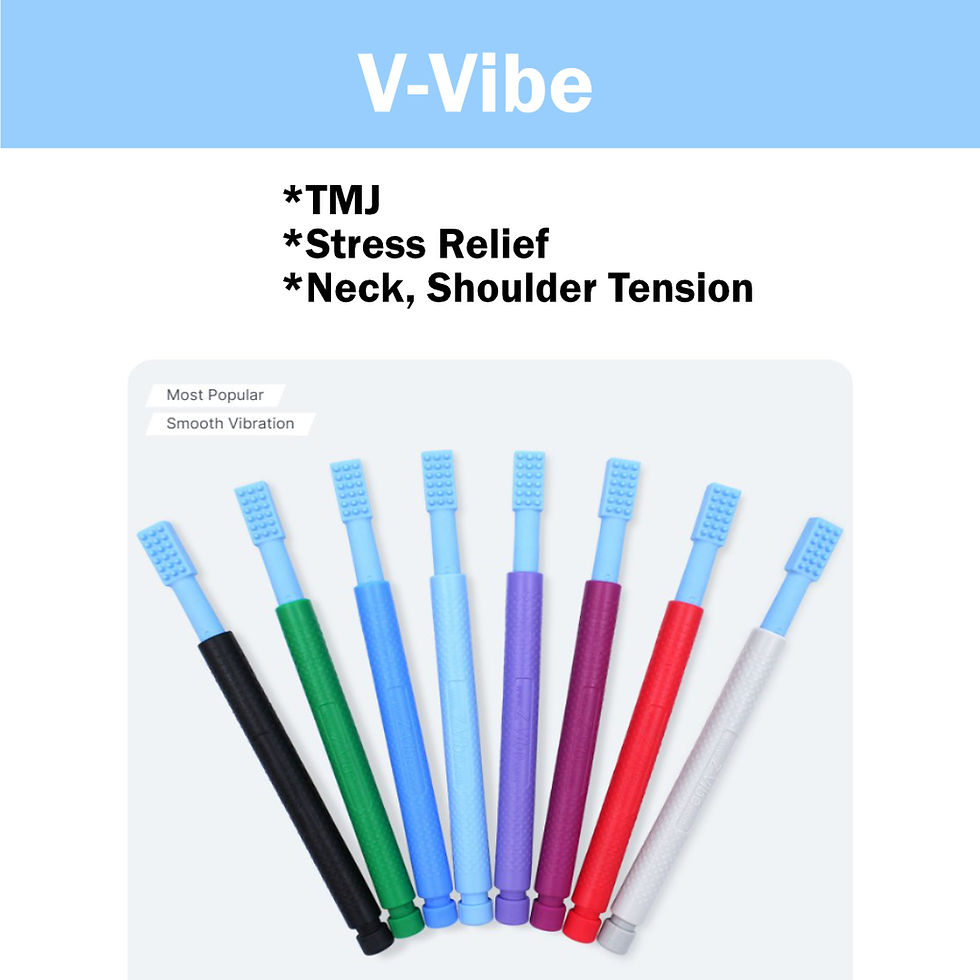
Because it delivers gentle vibration inside the mouth, it can reach tissues and muscles that are difficult to access from the outside (roof of mouth to drain sinus and the brain (Sometimes the brain can have collected too many toxins...That's another rabbit hole).
To use it, simply turn it on, gently glide it along your gums, and lightly bite down on it. The vibration may help encourage the jaw muscles, especially the masseter, to relax from the inside out. Try slightly biting down on it.
Since the muscles of the jaw, face, head, and neck all work together, easing tension in one area tends to also reduce tension in surrounding muscles. Many people describe the gentle vibration as deeply calming and relaxing.
While everyone's experience is different, I'm excited to explore how this tool may support:
TMJ comfort
Facial muscle tension
Neck and shoulder tension
Vagus never relaxation
Oral sensory awareness
Relaxation of the jaw
Overall nervous system regulation
Why I'm Interested in the Kit
If you're considering the Z-Vibe, I'd recommend starting with the complete kit.
One attachment I'm especially excited about is the tongue tip.
The tongue has the potential to be remarkable. From an embryology perspective, it is one of the earliest structures to develop and is an important part of the digestive tract. It also plays a major role in breathing, swallowing, posture, and jaw function.
Dr. Perry frequently teaches tongue pulls as a powerful way to encourage relaxation, improve breathing mechanics, and influence tension throughout the body. Adding gentle vibration to the tongue and other tissues inside the mouth opens up an entirely new way to explore1) the relationship between the mouth, jaw, digestion, and the nervous system.
I'm looking forward to experimenting with it and sharing what I learn.
Until then, if you're interested in learning more
Educational video

Comments